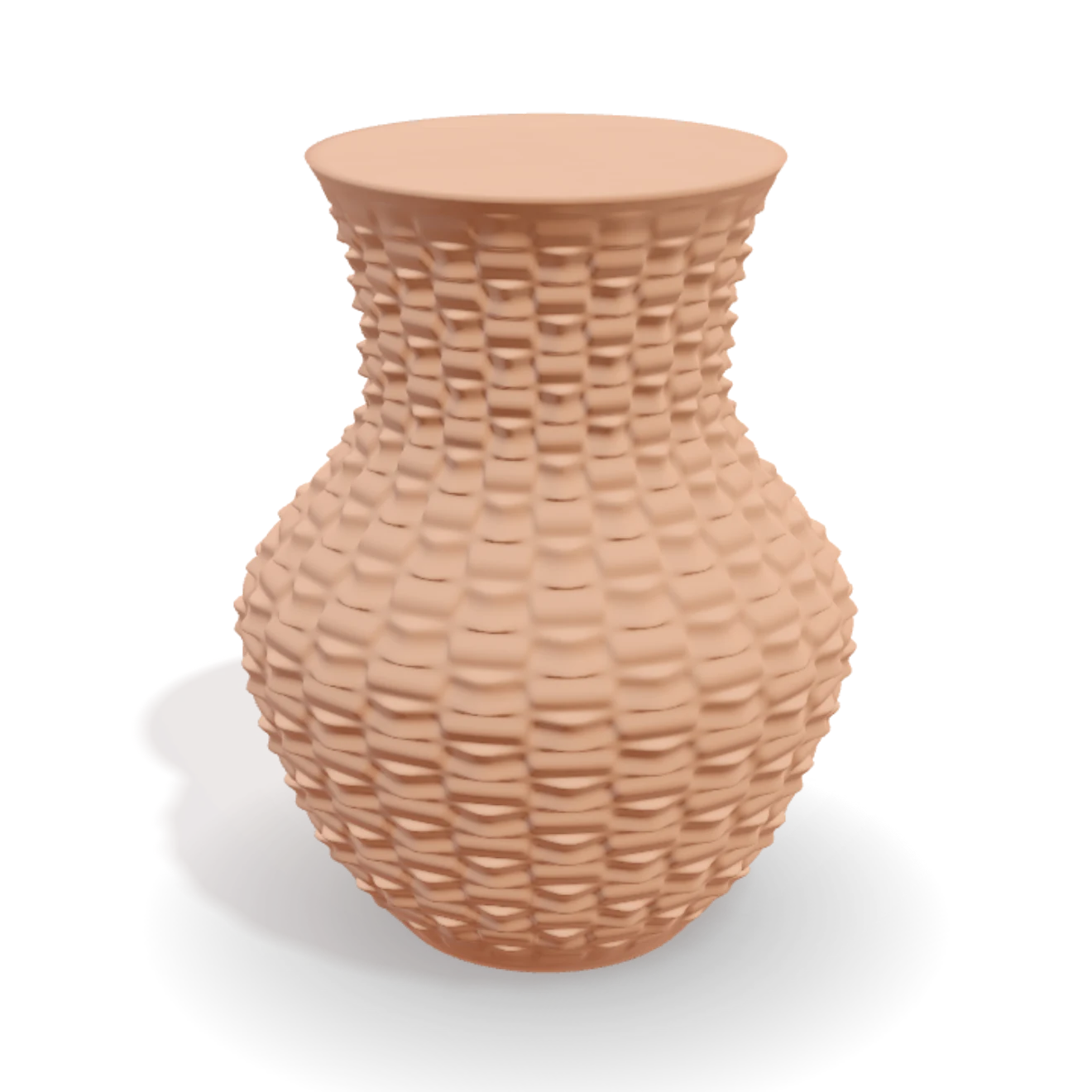
Why I built VASE 3D
For years the power to design a vessel parametrically was locked inside heavy CAD. I wanted that power on a wheel, where the shape itself is the thing you touch.
I came to this from both sides. I love throwing and I love code. The problem was always the same. The serious parametric tools could do anything, and they made me forget I was making a pot. I was managing a tree of operations and chasing a broken surface, not shaping a form. The friendly tools were the opposite. They were lovely to use and could not hold the precision a real part needs.
So I started VASE 3D with one rule. The vessel is the interface. You pull the wall, twist the body, pattern the surface, and the form responds the way clay responds. There is no separate modelling sandbox to mentally translate back into a pot. You work on the object you are going to make, and the controls sit on it.
The second rule is the one I care about most. Every shape is watertight by construction. The outer silhouette is revolved into one closed solid, so the geometry cannot spring a leak as you push it around. That guarantee is quiet, and it changes everything downstream. What you see on the screen is what comes out as a file. No repair step, no hoping the mesh survived the export, no surprise hole when you load it into a slicer.
It runs in the browser because a tool you want to open should open. No install, no license server, no machine that is the only one with the software on it. You shape a form by feel, pattern it from a large library, pour a glaze that actually flows and pools, and export a clean STL, OBJ or GLB ready to print. VASE 3D makes the master vessel. It does not make molds. That is a separate engine I am building upstream, and the vessel hands it a small sidecar to read later.
I build this alone, in Israel, one vessel at a time. That is slow, and it is also the point. Every part of the tool is something I use and something I would want to use. If you make something with it, I would genuinely like to see it.
— Afek