
Glossary
The words, in plain language.
Designing a vessel and printing one borrow vocabulary from two crafts that rarely share a room. A potter knows what a shoulder and a foot are. A printing maker knows what a perimeter and a seam are. Here are 47 of those words, each defined on its own terms, so neither side has to pretend to know the other's.
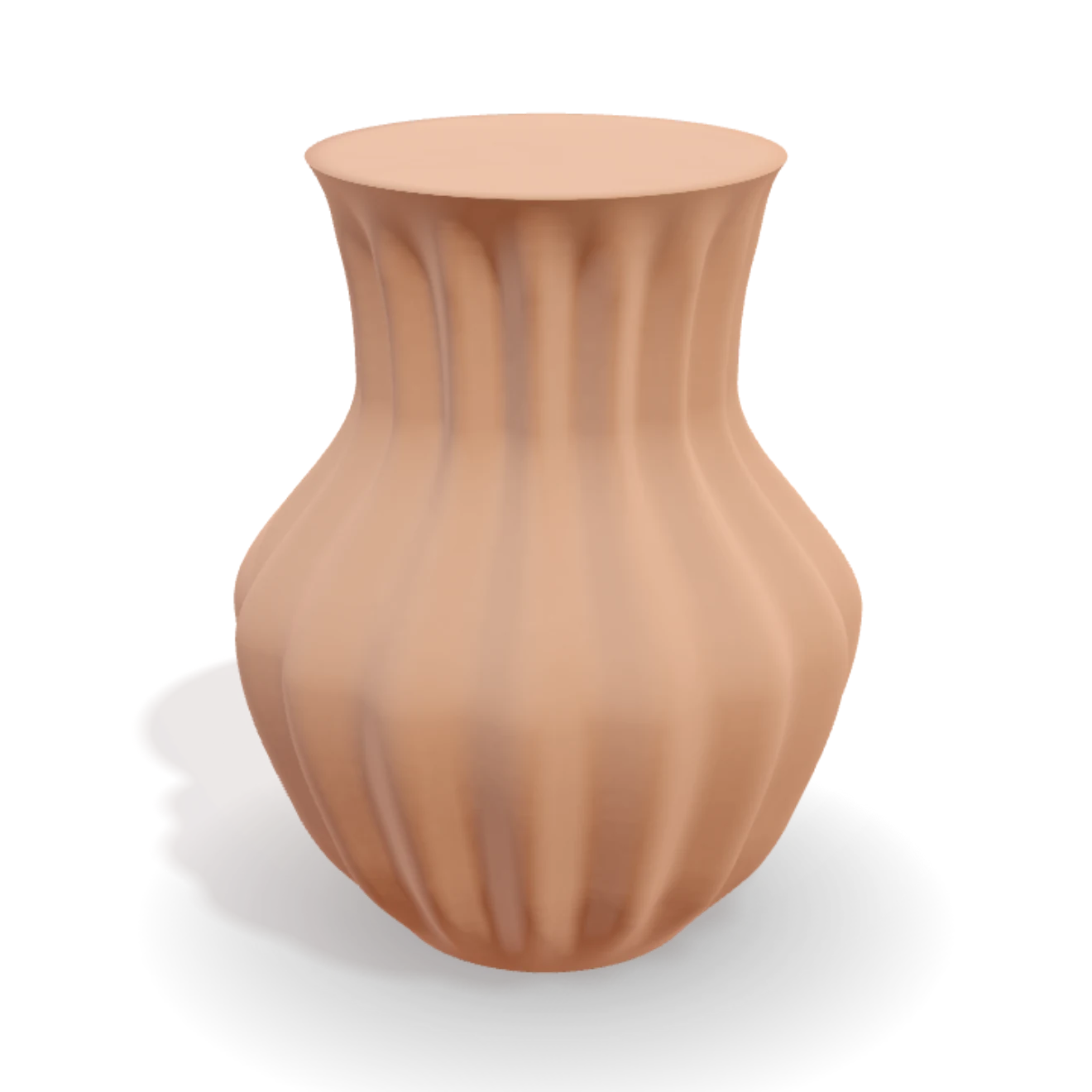
Every term
47 definitions, grouped by where the word comes up. Each one links straight to its entry.
Geometry and files
Printing
Finish and provenance
The vessel
The parts of a pot, in the words a potter uses at the wheel.
Vessel
A vessel is a hollow form made to hold something: a vase, a bottle, a bowl, a jar or a cup. In parametric design the word is useful because it names the whole family at once, without committing to which one a shape will turn out to be.
Profile
The profile is the outline of one side of a pot, drawn from foot to rim. Because a thrown or turned vessel is the same all the way round, that single curve decides the entire form, and changing the profile changes the pot everywhere at once.
Foot
The foot is the base a vessel stands on. A wider foot makes a piece stable and visually settled; a narrow one lifts it and makes it look lighter, at the cost of how easily it tips.
Belly
The belly is the widest part of a vessel's body. Where the belly sits along the height changes the character of a pot completely: low reads as grounded and generous, high reads as taut and rising.
Shoulder
The shoulder is where a vessel stops widening and turns in toward the neck. A soft shoulder flows; a sharp one gives the pot a defined edge that catches light along a hard line.
Neck
The neck is the narrowed section between the shoulder and the rim. Its length and how tightly it draws in set how much of a stem shows on a flower and how the pot reads from across a room.
Rim
The rim is the top edge of a vessel, where the wall ends. It is the part a hand meets first and the line an eye follows around the opening, so a small change here is felt out of proportion to its size.
Opening
The opening is the mouth of a vessel: the hole at the top and the face around it. Its width decides what the piece can hold and, for anything that will later be cast or moulded, whether the form can be got out of a mould at all.
Shaping
How a parametric vessel is actually made, and why it is not the same as sculpting one.
Parametric design
Parametric design means a shape is stored as the recipe that produced it rather than as a fixed lump of geometry. Every decision stays live and adjustable, so a form made this way can be reopened months later and changed at any step without starting over.
Surface of revolution
A surface of revolution is the shape you get by spinning a single profile curve around a central axis. It is the mathematical description of what a potter's wheel does, and it is why a pot made this way is automatically symmetrical all the way round.
Revolve
To revolve a profile is to sweep it a full turn around the axis to produce a solid. Building a vessel from one revolve, rather than by cutting pieces out of a block, is what makes the result closed and printable by construction instead of by repair.
Control point
A control point is one of the handles along a profile curve. Dragging a control point bends the curve near it and leaves the rest of the pot alone, which is what makes shaping feel like pushing on a wall rather than editing numbers.
Twist
A twist rotates a vessel's cross-sections progressively as they rise, so vertical detail leans into a spiral. A small twist gives a form movement; a large one turns straight ribs into a rope.
Taper
A taper scales a vessel's cross-sections gradually along its height, narrowing or widening the whole form without redrawing the profile. It is the quickest way to change a pot's stance while keeping its character.
Pattern order
Pattern order is the sequence in which surface effects are applied to a form. Order is a real parameter and not a detail of bookkeeping: a twist applied before ribbing produces a spiralling rib, and the same two applied the other way round produces a straight rib on a twisted pot.
Surface
Ornament vocabulary borrowed from ceramics, metalwork and architecture, where these names have meant the same thing for centuries.
Relief
Relief is decoration that stands out from, or sinks into, a surface while staying part of it. Because relief is depth rather than colour, it only reads when light rakes across it, which is why a relief that looks strong on a flat drawing can disappear on a lit object.
Fluting
Fluting is a series of concave grooves running down a form, most familiar from classical columns. On a vessel it lengthens the silhouette and breaks reflections into vertical bands.
Ribbing
Ribbing is a series of raised bands, the convex counterpart to fluting. Ribs catch a highlight on every crest, so a ribbed pot reads as brighter and busier than a fluted one of the same depth.
Gadroon
A gadroon is a rounded, lobed swelling, usually repeated around a form and often tilted so the lobes lean. Gadrooning is old silversmiths' and ceramics vocabulary, and it is what gives a melon-shaped bowl its segments.
Scales
A scale pattern is a field of overlapping rounded shapes laid across a surface, in the way roof tiles or fish scales overlap. Each row is offset from the one below, so the eye reads a texture rather than a grid.
Faceting
Faceting replaces a smooth curve with a set of flat planes meeting at edges. A faceted pot reflects light in discrete panels instead of a continuous gradient, which is why faceting reads as crisp and cut rather than thrown.
Girih
Girih is a family of interlaced geometric strapwork from Persian and Islamic architecture, built from a small set of repeating tiles that generate complex non-repeating-looking patterns. It is ornament with a strict underlying construction, which is exactly what makes it possible to generate rather than draw.
Geometry and files
The words that decide whether a model prints or fails, and what they actually mean.
Watertight
A watertight model is one whose surface is completely closed, with no holes, gaps or missing faces, so there is an unambiguous inside and outside. The name is literal: if you filled the shape with water, none would leak out. Slicers need this, because a hole leaves them no way to know what is solid.
Manifold
A manifold mesh is one where the geometry is locally sensible everywhere: every edge joins exactly two faces, and the surface never passes through itself. Manifold and watertight are often used interchangeably in print forums, but they are separate checks and a model can fail one while passing the other.
Non-manifold geometry
Non-manifold geometry is any place a mesh describes something physically impossible, such as an edge shared by three faces, two shells touching at a single point, or a face with nothing on the other side. It is the most common reason a model that looks fine on screen fails in a slicer.
Solid
A solid is a model whose surface encloses a filled volume. Exporting a solid rather than a hollow shell leaves the wall thickness to the slicer, which is where that decision belongs, because the right thickness depends on the printer and the material and not on the design.
Shell
A shell is a model that has already been hollowed, so it carries both an outer and an inner surface with a fixed wall between them. Shells are fragile to edit and easy to break: any change to the outside has to be matched exactly on the inside or the wall thickness goes wrong.
Single body
A single body means the whole model is one connected piece rather than several separate lumps that happen to sit near each other. Vase-mode printing requires this, because the slicer traces one continuous outer contour per layer and a second island has nowhere to go.
Winding and normals
Winding is the order a triangle's corners are listed in, and it determines which way that triangle faces. Consistent winding across a whole mesh is what tells a slicer which side is outside; an inverted triangle turns a small patch of the surface inside out, and a print can fail on it.
Tessellation
Tessellation is the division of a smooth mathematical surface into the flat triangles a mesh file can store. More triangles follow a curve more closely and produce a larger file; too few, and a curve that is smooth in the design shows visible flats in the print.
STL
STL is the oldest and most widely accepted 3D printing format. It stores nothing but a list of triangles, with no colour, units or structure, which is both why it is universal and why every other kind of information has to travel separately.
OBJ
OBJ is a plain-text 3D format that stores geometry along with texture coordinates and material references. It is a good choice when a model is heading for rendering or further modelling rather than straight to a printer.
GLB
GLB is the single-file binary form of glTF, the modern format for delivering 3D on the web. It packs geometry, materials and textures into one compact file, which is what makes it the right choice for viewing a piece in a browser or sharing a preview.
Printing
What happens after the file leaves the studio.
Slicer
A slicer is the program that turns a 3D model into instructions a printer can follow, by cutting it into layers and planning a path for each one. The model decides the shape; the slicer decides wall count, infill, supports and speed.
Vase mode
Vase mode is a slicer setting that prints a model as one continuous single-wall spiral, with the nozzle climbing steadily instead of stopping and starting each layer. Cura calls it Spiralize Outer Contour; PrusaSlicer, Bambu Studio and OrcaSlicer call it Spiral vase.
Spiralize
Spiralize is the other common name for vase mode. It describes the mechanism directly: rather than closing each layer and stepping up, the printer raises the nozzle continuously so the whole wall becomes one unbroken helix with no layer seam.
Layer height
Layer height is the vertical thickness of each printed layer. Smaller layers resolve fine surface detail and take proportionally longer; on a vessel it is the single setting that most changes how visible the print's own texture is against the designed one.
Wall
A wall, also called a perimeter, is one pass of the nozzle around the outside of a layer. Most prints use several walls for strength; a vase-mode print uses exactly one, which is why its thickness has to be set by the nozzle width rather than by adding more.
Bottom thickness
Bottom thickness is how many solid layers a print puts down before the walls begin. In vase mode it is the setting that gives a pot an actual floor, and setting it to zero produces a tube open at both ends.
Overhang
An overhang is any part of a print that leans out beyond what the layer below it supports. Shallow overhangs print cleanly on their own; past roughly forty-five degrees from vertical most printers need supports or the surface sags.
Bridging
Bridging is printing a span of material across an open gap with nothing underneath. A printer can bridge a surprising distance if the plastic is cooled hard enough, which is why fan settings matter more on bridges than anywhere else.
Seam
The seam is the vertical line left where each layer starts and stops. It is the most common blemish on a printed vessel, and it is also the reason vase mode looks so clean: a continuous spiral never stops, so it has no seam to show.
Infill
Infill is the internal lattice a slicer prints inside a solid model to give it strength without filling it completely. Infill is a slicer decision rather than a modelling one, which is why exporting a solid, and letting the slicer hollow it, gives a maker more control than exporting something already hollow.
G-code
G-code is the list of movement and temperature instructions a printer actually executes, produced by the slicer. It is specific to one machine and one set of settings, so it is the end of the pipeline and never a format to design or share a shape in.
Finish and provenance
How a piece looks when it is done, and how it stays attributable to the person who made it.
Glaze
In ceramics a glaze is a glassy coating fused onto a fired pot, which seals the surface and carries its colour and depth. In a digital studio a glaze preview stands in for that: a material simulation that shows how a finish would pool, break over relief and catch light, before anything is printed or fired.
Maker's mark
A maker's mark is the stamp a potter presses into the base of a piece to say who made it. It is the oldest form of provenance in the craft, and it survives the move to digital unchanged: a mark carved into the base of an exported model does the same job in the same place.
Bottom mark
A bottom mark is a mark carved into the underside of a printed vessel, where a potter's stamp would go. Because it is real geometry rather than a texture, it prints as part of the piece and cannot be stripped out of the file.